


SciCan VistaHub Installation Guide
In the world of sterilization, any device you use, whether it’s autoclaves, instrument washers or anything else, is only as good as it’s plumbing. Wastewater drainage is a very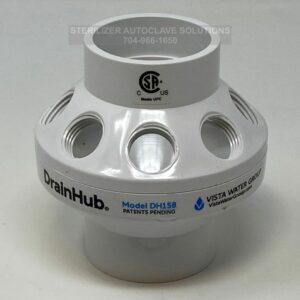 important part of the process, as it keeps any devices you use properly cleaned and saves them from any issues that can arise if leftover wastewater isn’t properly dealt with. And with the SciCan VistaHub multi-port drain hub, plumbing has never been more seamless. It saves space by ensuring your plumbing fixtures can be connected at one simple-to-install drainage hub for all your wastewater drainage needs. And with the VistaHub’s adaptability, you can connect it to various types of pipes so you’re not stuck trying to find a new adapter for everything.
In this article, however, we’d like to focus on where it all starts, installation. Proper installation is paramount for any device in this industry, as it can mean the difference between a successful start, or a failed launch… And with plumbing, that’s not a mess you want to clean up. So this article will focus on the SciCan VistaHub Installation Guide. With instructions for proper installation provided by SciCan themselves.
If you have any questions about the SciCan VistaHub, its installation or anything else, please give us a call at 704-966-1650 Option 3 for our Free Tech Support Line, and one of our technicians will be able to help.
Installation Guide
DrainHub is a plumbing waste fitting that can receive multiple drain lines from various types of appliances and devices.
Its 1/2” NPT threaded ports accept a variety of push-to-connect, compression, and hose barb adapter fittings—many of which are available at DrainHub.com.
Materials & Dimensions
- Schedule 40 PVC
- 1/2” NPT threaded inputs (2, 4 or 8)
- Top & bottom slip hubs accept 1-1/2” pipe
- Bottom hub O.D. glues into 2” coupling
- Codes & Standards Compliance
- ASTM D2665 (PVC)
- ASTM F1498 (Threads)
- ASME A112.18.2-2015
- CSA B125.2-15
- FDA Title 21 Material
Please read this entire guide before proceeding with installation and use, and always follow local plumbing codes.
DrainHub Position Under Sinks
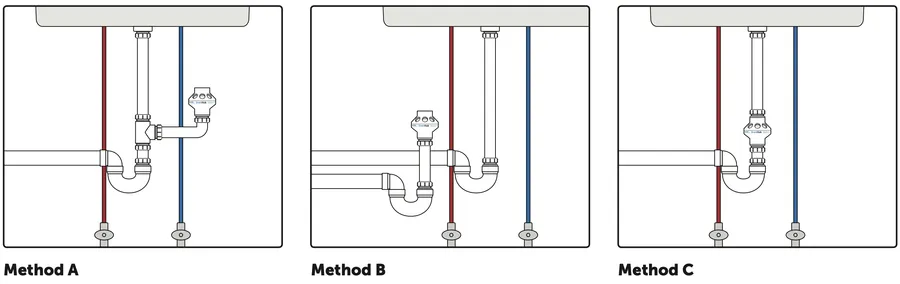
Method A: Installation beside the main drain line can offer maximum flexibility and can be achieved with the use of a simple drain tee adapter fitting. This preferred method of installation is especially appropriate for receiving cooled autoclave exhaust consisting of both liquid condensation and air in the waste stream to avoid “bubbling” in the sink.
Method B: When possible, as in cases of new construction, it can be beneficial to run parallel drain waste systems to separate waste from the sink from other appliances and devices.
Method C: When necessary, it is possible to install the DrainHub fitting directly in the main drain line under a sink. However, this position can result in more audibly noticeable drainage of waste containing a significant amount of air, such as cooled autoclave exhaust, and “bubbling” in the sink.
Connection to Waste Lines
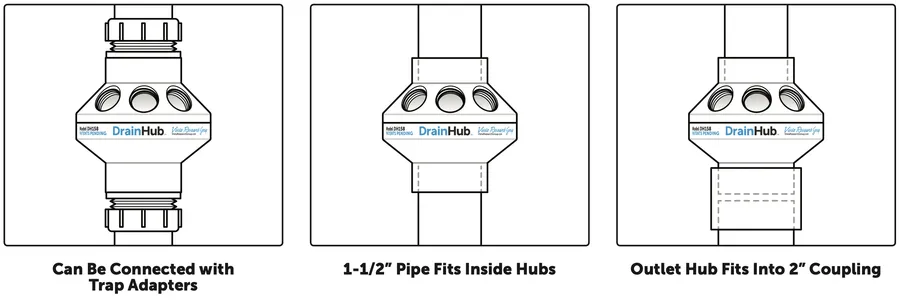
The top and bottom hubs of the DrainHub fitting are designed to accommodate standard 1-1/2” or 2” pipe, or standard 1-1/2” trap adapters for use with 1-1/2” or 1-1/4” tubular waste lines.
Top-of-Fitting Connection Options
When not installed inline with a main waste line, such as directly under a sink, the top hub of the DrainHub fitting can accommodate various connections. Please consult a licensed plumbing professional to determine the best top-of-fitting connection option, considering the intended use scenario and local code requirements.

As always if you have any questions about this process or anything else please feel free to contact us and take advantage of our “FREE TECH SUPPORT.”
We also offer FREE VIRTUAL TECH SUPPORT to “See and Talk” with a “Real Time Live Technician” for any problems you may be in need of help with.
You can also use our “FREE MAINTENANCE PROGRAM”. Take the guesswork and worrying about what unit is due for maintenance and which maintenance cycle it is time for. We will keep track of all your autoclaves and let you know when it’s time for anything.
You can find more info on the SciCan VistaHub Drain Hub on our website here.