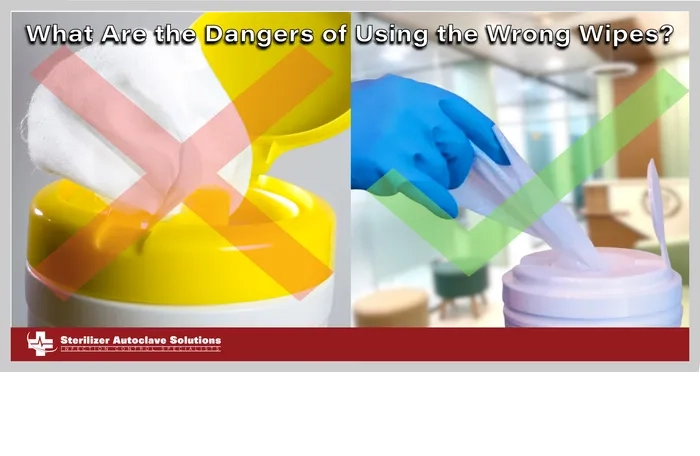
What Are the Dangers of Using the Wrong Disinfectant Wipes?
In our daily lives, we’ve been conditioned to reach for the nearest canister of wipes to handle a spill or a sneeze. In a home or office, that convenience is a luxury; in a medical environment, it is a liability. While household wipes are marketed as a universal solution for germs, the reality is that a “clean-looking” surface in a clinic or hospital can be a dangerous illusion.
Using a generic wipe in a professional healthcare setting isn’t just a minor oversight. It’s a choice that actively undermines the safety of patients and the integrity of expensive medical tools. To understand why we must look past the convenience of the grocery store aisle, we have to look at the invisible science of what happens when the wrong chemistry meets a high-stakes environment.
Elimination Capabilities
The first point to make is one of the simplest, and it’s that your generic wipes aren’t up to snuff. In a basic environment, say your business office or your home, you won’t run into “hardy” pathogens. You’ll see your run of the mill flu viruses or even E.coli, but that’s about all they can help with. Household wipes are mainly meant to sanitize. Most generic wipes rely on quarternary ammonium compounds, or quats to get the job done. Quats are effective against enveloped viruses like influenza, but fail against non-enveloped viruses.
In a medical setting where sterilization is the key word, generic wipes cannot be used. By only eliminating smaller pathogens, there’s so much more left to chance. Especially in an environment that deals in diseases, bodily fluids and other hazards beyond the normal scope. Using any wipe in a professional setting without an EPA registered kill claim is dangerous. Healthcare associated infections (HAIs) are required by these standards to be eliminated by a product that has the proper efficacy claims to actually eliminate them.
Trying to use household disinfectants on superbugs or intense spores will just lead to a new, worse environment. The minor virus cells will be killed, but that just means that the tougher pathogens can now grow without obstruction, and just create more problems.
The Dangers of Bioburdens
Bioburden—the invisible danger of bacteria, viruses, and organic “gunk” living on the surface. Bioburdens are harmful buildups that can be harmful to the user even after wiping a surface down, thinking it’s disinfected. The danger of bioburdens is they it create a physical substance that remains on a surface even after wiping it down. Microorganisms don’t just sit on a counter alone, they group together under layers of organic waste. If this bioburden isn’t stripped away immediately, it matures into a biofilm.
While medical-grade wipes are formulated with powerful surfactants to remove them, generic wipes often lack the strength to break that seal. Instead of eliminating the threat, a weak wipe simply picks up the bioburden and moves it. Because the cleaning chemicals in household wipes aren’t powerful enough, you aren’t actually disinfecting anything. You’re just moving the problem around, leaving more room for even more bacteria to thrive and just add to the existing issue.
That’s why products that use Accelerated Hydrogen Peroxide (AHP) are listed as the most effective way to combat this issue. AHP breaks everything down into a removable substance, which ensures its removal, and leaving no danger behind… Unlike the other kinds of wipes, like alcohol based wipes, or wipes that utilize quats.
Potential Damage to Your Tools
If you have a generic wipe, chances are you’re using it on more than what it’s intended for. Which some people don’t fully realize, but there’s a reason that the packaging says that. We often choose wipes based on their ability to kill germs, but we rarely consider how those chemicals interact with the expensive equipment they touch. Most generic household wipes rely on alcohols or harsh quats that are notoriously incompatible with medical-grade materials. When these chemicals sit on professional-grade plastics, or touchscreens, they trigger a process called environmental stress cracking.
These microscopic cracks are more than just cosmetic damage; they are a permanent failure of infection control. Once a surface is pitted, it becomes a safe harbor for bacteria. The cracks can be deep enough to protect germs from the next round of cleaning. Allowing them to hide and survive even the strongest disinfectants. Essentially, by using the wrong wipe, you are physically transforming a smooth, cleanable tool into a porous hideout for pathogens. No matter how much you wipe a damaged surface, you can never truly reach the bacteria hiding inside the cracks.
Beyond the germ risk, there is the literal cost of equipment failure. Many generic wipes leave behind a sticky, chemical residue that builds up over time, eventually “clouding” expensive diagnostic screens or causing buttons and sensors to stick and malfunction. In contrast, medical-grade solutions like Accelerated Hydrogen Peroxide (AHP) are designed to be “materially compatible.” They provide high-level disinfection without the corrosive side effects, ensuring the surface stays undamaged, and the equipment stays in working order.
The Illusion of Cleanliness
Have you ever walked into a room that smells like lemon cleaner and thought “someone must’ve cleaned recently?” That mentality is more prevalent than you think, to the point of studies being done to prove it being a very real problem. The scent given off by generic cleaning solutions can lead to a false sense of security. You smell scented cleaner, and you assume the room is clean, or has been cleaned within a short time. Studies show that it creates a sort of mental aversion to the true danger of a simple wipe down.
Matt Wonnacot, an expert in the air care and scent industry for 20 years, published a study on this. His findings led him to some key points, but the one we’d like to focus on is this: Wonnacot’s study showed that scent strongly influences the perception of hygiene. Clean-coded scents like citrus improved perceived cleanliness by up to 40%, even when cleaning routines were unchanged.
This study shows that even when nothing is changed, the illusion of cleanliness can still be created. Something like this has the potential to cloud judgement or get rid of any further investigation. Using a household wipe that produces a clean scent just to get the job over with can lead to major problems down the line. Like all of the previous points have shown. You’ll find that most medical grade disinfectants and cleaners will have a potent odor, or even be made to be odorless. So be sure that you’re using the right solution, even if it doesn’t smell the greatest.
Final Thoughts
Ultimately, the goal of medical disinfection isn’t to make a room smell like a summer breeze; it is to break the chain of infection. As we’ve seen, the gap between a generic wipe and a medical-grade solution is measured in more than just savings—it’s measured in efficacy, material compatibility, the elimination of the invisible bioburden that shields our most dangerous pathogens, and more.
Choosing the right wipe, such as those utilizing Accelerated Hydrogen Peroxide (AHP), ensures that we aren’t just moving germs around or accidentally creating hiding spots in damaged equipment. It’s time to stop relying on the sensory “illusion of clean” and start relying on validated, clinical-grade science. In the world of healthcare, the right wipe doesn’t just clean a surface… it eliminates potential danger.
If you have any questions about which wipes are right for you, give us a call at 704-966-1650, and we’ll help you find what you need. You can also check out our collection of wipes and solutions on our site here.
As always if you have any questions about this process or anything else please feel free to contact us and take advantage of our “FREE TECH SUPPORT.”
We also offer FREE VIRTUAL TECH SUPPORT to “See and Talk” with a “Real Time Live Technician” for any problems you may be in need of help with.
You can also use our “FREE MAINTENANCE PROGRAM”. Take the guesswork and worrying about what unit is due for maintenance and which maintenance cycle it is time for. We will keep track of all your autoclaves and let you know when it’s time for anything.