
What is the Current Threat of Animal-Origin Viruses?
The boundary between animal health and human safety is becoming increasingly thin as emerging viral threats begin to cross the species barrier. The world’s focus has largely been on already established viruses, the things we have information on and know how to deal with. But there are always invisible threats brewing on the cellular level. Invisible risks like the ones we’re looking at in this article, Influenza D and Canine Coronavirus.
These viruses, once confined to livestock and domestic pets, are showing a troubling capacity for human transmission and respiratory adaptation. As surveillance efforts struggle to keep pace with these evolving threats, the responsibility for prevention falls heavily on the front lines of clinical and veterinary hygiene.
In this article, we’d like to look at an article from Healthcare Hygiene Magazine that talks about the current state of these two viruses: what some experts are saying, and why they pose potential danger. We even have a solution to help disinfect your veterinary practice to keep these pathogens at bay.
What is the Emerging Threat of Animal-Origin Viruses?
A recent article from Healthcare Hygiene Magazine talks about a veterinary viral situation. With two animal-origin viruses on everyones radar; Influenza D and Canine Coronavirus. These two viruses have been primarily associated with livestock and domestic pets. But evidence is showing that it can spread beyond the barrier of species, and spread to humans.
A team of infectious disease experts wrote an article in the January issue of the CDC’s Emerging Infectious Diseases journal. They mention that if surveillance and diagnostics continue to lag, influenza D and canine coronavirus have dangerous outbreak potential. Dr. John Lednicky, a research professor at The University of Florida’s College of Public Health and Health Professions, had this to say, “Our review of the literature indicates these two viruses pose respiratory disease threats to humans, yet little has been done to respond to or prevent infection from these viruses.” Lednicky also warned, “If these viruses evolve the capacity to easily transmit person to person, they may be able to cause epidemics or pandemics since most people won’t have immunity to them.”
What is the Concern With Influenza D?
Influenza D virus, first identified in 2011, is a significant burden on the livestock industry, contributing to bovine respiratory disease. When it was first identified, it was found in a pig in the state of Oklahoma. But further investigation later determined that it specifically targeted cattle. It’s much more distinct from other types of influenza, only sharing around 50% of its genetic makeup with other types. The closest in type to influenza D is influenza C.
While it has long been seen as an animal health issue, surveillance studies have shown that human exposure is remarkably high, particularly among those in close contact with animals. In some regions, up to 97% of cattle workers tested carried antibodies for the virus. While these infections have been subclinical so far, scientists are wary of the virus’s ability to adapt.
Lednicky said about influenza D: “So far, influenza D has not been associated with serious infections in humans.” “However, canine coronavirus has, but diagnostic tests are not routinely performed for the cirous so the extent at which the virus affects the population at large is not known.” Which takes us to the article’s second point on the subject: canine coronavirus.
What is the Concern With Canine Coronavirus?
Canine coronavirus (CCoV) presents a different but equally troubling scenario. Traditionally known for causing gastrointestinal issues in dogs, new recombinant strains are now emerging that target the human respiratory system. Strains like CCoV-HuPn-2018 have been detected in patients with respiratory illnesses across several countries, including the United States.
Dr. Lednicky notes that while influenza D has not yet been linked to serious human illness, “canine coronavirus has, but diagnostic tests are not routinely performed for the virus so the extent at which the virus affects the population at large is not known.” This lack of testing means the virus can circulate and evolve without being detected by standard medical screenings.
What Are the Challenges in Surveillance and Prevention?
The primary challenge in managing these threats is a significant lag in surveillance and diagnostic testing, which creates a dangerous blind spot for public health officials. Experts emphasize that the limited data available should be taken as a serious warning sign.
In their review, the authors conclude, “Our knowledge is about the viruses’ epidemiology and clinical manifestations are limited to a modest number of research studies.” They wrote: “Even so, the limited data regarding these novel, newly detected viruses indicate that they are a major threat to public health.” The lesson from past pandemics is clear: waiting for a crisis to force action is a costly strategy. To prevent a localized spillover from becoming a global emergency, scientists argue that the world needs better virus monitoring, more reliable tests, and a proactive investment in treatments and vaccines.
But for the common reader, the ones who have to bolster infection control practices in their own veterinary practice… What can you do to ensure that these two viruses don’t make it past the metaphorical waiting room? There is one surefire solution, and it’s one of the best places to start. One of the steps in infection control that, in recent years, has been left by the wayside in a lot of ways, but is still vital: surface disinfection.
What Can You Use To Contain the Spread?
Should you encounter either of these pathogens in your veterinary practice, there’s no need to worry. Influenza strains and Coronavirus pathogens are things we’ve been dealing with for years. One of the best modern weapons we have against the pathogens starts on the surface, with AHP.
AHP, or Accelerated Hydrogen Peroxide, is a surface disinfection formula that has turned the tables of surface disinfection in recent years. AHP is a formula that possesses the ability to eliminate even the toughest of pathogens, enveloped or not.Its strength lies in its rapid, broad-spectrum performance, capable of neutralizing bacteria, viruses, and fungi in as little as 30 to 60 seconds. Unlike traditional disinfectants that often require multiple applications to keep a surface wet for the necessary “kill time.” AHP‘s superior efficacy allows a single wipe to achieve total disinfection. This not only streamlines the cleaning process but significantly reduces waste and costs. Providing nearly double the disinfecting power of generic alternatives with half the material.
The active ingredient naturally breaks down into nothing more than water and oxygen, it leaves behind no toxic chemical residue or harmful bioburden. This makes it non-irritating to the eyes, skin, and respiratory tract. By combining biodegradable surfactants with this clean-breakdown chemistry, AHP offers a professional-grade solution that protects the user, the equipment, and the planet simultaneously.
What Are Optim1 Wipes?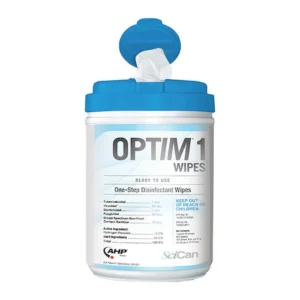
When it comes to AHP solutions, the most iconic on the market is the reliable Optim1 wipes.
In a busy clinical environment, the most significant barrier to effective disinfection is “dwell time”—the amount of time a surface must remain wet to actually kill a virus. Unlike traditional cleaners that often require 10 minutes of wetness to be effective, Optim 1 is designed for the reality of a fast-paced workflow:
- Rapid Kill Times: It is a true one-step cleaner and disinfectant that neutralizes enveloped viruses (like coronaviruses and influenza) in as little as 30 to 60 seconds.
- Superior Cleaning: It contains surfactants that remove organic debris and “bioburden” while it disinfects, ensuring pathogens aren’t shielded by dirt or grime.
- Safety Profile: It carries the EPA’s lowest toxicity rating (Category IV). It requires no GHS hazard pictograms or warning labels because it is non-irritating to the skin, eyes, and respiratory system.
- Environmental & Equipment Friendly: The active ingredient breaks down into simple water and oxygen, leaving no active residues that could damage expensive clinical equipment, dental chairs, or medical-grade upholstery.
By implementing a high-speed AHP disinfectant like Optim 1 as a daily standard, clinics can effectively close the “surveillance gap.” This proactive approach ensures that even “invisible” or emerging viral threats are neutralized the moment they hit a surface, providing a critical layer of defense long before an official diagnosis is even made.
Final Thoughts
The emergence of viruses like Influenza D and Canine Coronavirus serves as a stark reminder that our global health depends on proactive, rather than reactive, measures. While we cannot always predict when a virus will make the jump to humans, we can control the environment in which it lands. Ultimately, staying ahead of an outbreak requires a commitment to both scientific surveillance and the highest standards of daily disinfection, ensuring that the clinics of today don’t become the epicenters of tomorrow’s crisis.
But that doesn’t mean that we can’t do anything in our daily workplaces to help contain a potential spread. Proper infection control has been proven to help in many ways. Using the right tools to eliminate pathogens where they’re present is just as important as anything else. By moving away from slow-acting, harsh chemicals and adopting advanced technologies like Accelerated Hydrogen Peroxide, healthcare and veterinary professionals can ensure that emerging pathogens are stopped at the surface level.
If you’d like to read the full story from Healthcare Hygiene Magazine, you can find the link here. If you have any questions about disinfection and infection control products, or anything else, give us a call at 704-966-1650 and well help you find what you need.
As always if you have any questions about this process or anything else please feel free to contact us and take advantage of our “FREE TECH SUPPORT.”
We also offer FREE VIRTUAL TECH SUPPORT to “See and Talk” with a “Real Time Live Technician” for any problems you may be in need of help with.
You can also use our “FREE MAINTENANCE PROGRAM”. Take the guesswork and worrying about what unit is due for maintenance and which maintenance cycle it is time for. We will keep track of all your autoclaves and let you know when it’s time for anything.