

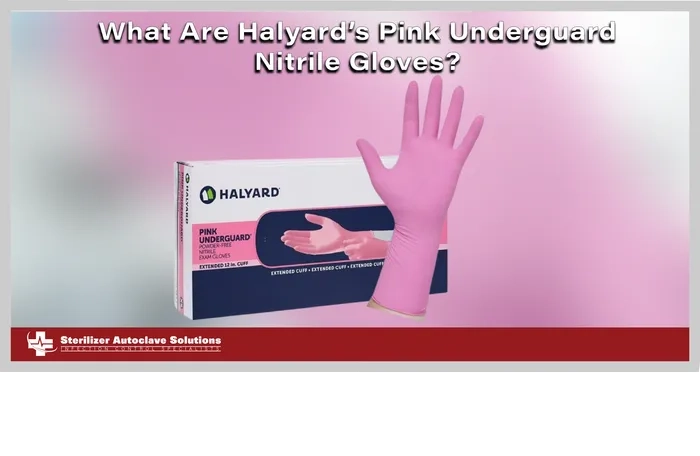
What Are Halyard’s Pink Underguard Nitrile Gloves?
We’ve talked about general personal protection equipment, like your standard fare of nitrile gloves. But in this blog, we want to go over one of the more underappreciated kinds of nitrile gloves that may go under your radar. Specifically, we mean Halyard’s Pink Underguard Nitrile gloves. We want to go over the various aspects that make them more unique than others. Like their specific use case, how they work, and especially taking a look at what double gloving is and why it’s so important.
What is Nitrile?
Nitrile comes from a synthetic rubber polymer. A copolymer to be precise. Copolymers come from two monomers, in this case, acrylonitrile and butadiene. These monomers are placed into a vat and put through the process of polymerization. A process of reacting monomer molecules together in a chemical reaction to form polymer chains or three-dimensional networks.
Unlike their traditional counterparts, nitrile gloves offer exceptional benefits and protection. This includes robust chemical resistance, making them capable of handling potent substances like chemotherapy drugs. When it comes to durability, nitrile has it in spades; it is three to four times more puncture-resistant than latex, making it indispensable for handling sharp objects.
Beyond their robust physical protection, nitrile gloves are engineered for user comfort and safety. They are entirely free of the natural rubber proteins found in latex, eliminating the risk of allergic reactions for the wearer. Once donned, the material utilizes the user’s body temperature to form a precise, comfortable fit, while their naturally frictionless surface eliminates the need for messy powders.
Furthermore, their waterproof nature, extended shelf life, and ability to withstand demanding conditions make them the preferred solution all across the industry. Including the industrial, medical, and food service industries.
What is Double Gloving?
To understand these gloves, you have to look at why double gloving is such an important part of medical work. In the medical world, double gloving is the practice of wearing two layers of medical-grade gloves. An inner glove and an outer glove simultaneously. It’s usually used during high-risk surgical procedures and when handling hazardous substances that can’t be deterred with a standard medical glove.
Double gloving is critically important because it provides a vital layer of redundancy against barrier failure. Standard medical gloves are susceptible to micro-punctures, tears, and degradation caused by the hazards of the environment. Things like surgical tools, strong chemicals and the like. If the outer glove is compromised, the glove underneath provides backup protection. Which can help prevent exposure to any number of dangers in that scenario.
How Do Halyard’s Pink Underguard Gloves Change the Game?
Aside from having Halyard’s tried and true protective barrier, there are ways they’ve improved upon the grievances with double gloving. The first thing to note is that they solved the issue of friction when double gloving. Usually when double gloving, the material creates friction, making it more difficult to cleanly don another pair. But with Halyard’s Pink Underguard Nitrile Gloves, they have a low-friction exterior coating, eliminating the difficulty of donning.
The Pink exterior isn’t just for show either. Since the Pink Underguard gloves are worn under a contrasting glove, it provides easy breach detection. If your top glove is torn or penetrated, that pink hue will provide fast detection so you can take action. And, being paired with a 12 inch beaded cuff just adds to the protection. With a longer cuff, the under glove can sit higher under the forearm. The length lets it sit under the cuffs of a gown to eliminate gaps in your protection.
What Are Halyard’s Pink Underguard Nitrile Gloves?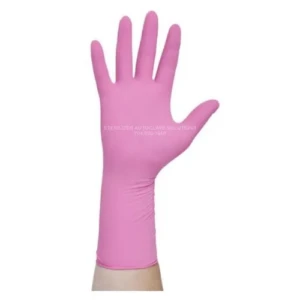
Halyard’s new Pink Underguard Nitrile Gloves are one of Halyard’s newest in personal protection equipment. The Pink Underguard gloves offer a mid-range layer of protection within Featuring a 3.5 mil palm and 4.7 mil fingertip thickness, while providing exceptional resilience. But that’s not where they really shine. Halyard’s Pink Underguard gloves are meant to be used in tandem, worn underneath another pair of gloves through double gloving. This helps provide a more robust layer of protection with its own set of benefits.
Halyard designed the Pink Underguard with a specialized low-friction exterior coating that allows a contrasting outer glove—such as a purple or gray nitrile exam glove—to slide on smoothly and effortlessly.
Beyond ease of donning, these gloves offer critical safety features tailored for high-risk environments. The vibrant pink color acts as an immediate visual breach indicator; if the outer glove is torn or punctured during a procedure, the bright pink material clearly shows through to alert the wearer. They also feature an extended 12-inch cuff that reaches high up the forearm to tuck securely underneath chemotherapy gowns, preventing chemical exposure at the wrist. Furthermore, the durable nitrile material is rigorously tested against 52 different chemotherapy drugs. As well as boasting an AQL of 1.0, ensuring a very low probability of defects in every box.
Designed for both safety and comfort, these gloves are entirely rubber latex-free to prevent Type 1 allergic reactions. Their powder-free construction also eliminates the risk of the irritation, dryness, and dermatitis often caused by powdered gloves. For the wearer, the material conforms to body heat to maintain high dexterity and tactile sensitivity, while the ambidextrous design ensures they fit either hand perfectly.
But if you want to know more information on these gloves, take a look at the specification tables below.
| PHYSICAL PROPERTIES: | |
| Sterile | No |
| Size | Medium |
| Materials | Nitrile |
| Primary Product Color | Pink |
| Single Use | Yes |
| Ambidextrous | Yes |
| Textured Fingertips | Yes |
| Not Made with Natural Rubber Latex | Yes |
| Powder-Free | Yes |
| Tensile Strength Before Aging | 42 MPa (Target) |
| Tensile Strength After Aging | 38 MPa |
| Ultimate Elongation Before Aging | 650% |
| Ultimate Elongation After Aging | 550% |
| AQL | 1.0 |
| Cleared for Use With Chemotherapy Drugs | Yes |
| Chemotherapy Drug Details | 52 Drugs |
| Shelf Life | 3 Years |
| GLOVE DIMENSIONS: | |
| Pink Underguard Glove Length | 12" - 304.8mm |
| Middle Finger Length | 3.22" - 82mm |
| Width of Palm | 3.74" - 95mm |
| Fingertip Thickness | 4.7mil - 0.0047" - 0.12mm |
| Palm Thickness | 3.5mil - 0.0035" - 0.09mm |
| Cuff Thickness | 2.8mil - 0.0024" - 0.07mm |
Final Thoughts
When it comes to advanced hand protection, details like friction reduction, color contrasting, and cuff length can make all the difference. Halyard’s Pink Underguard Nitrile Gloves are a unique entry into the world of PPE. Proving that personal protective equipment can be both remarkably tough and intuitively designed. Whether you are outfitting a surgical suite or upgrading your facility’s safety protocols, understanding the science behind your PPE is the first step toward a safer, more secure workspace.
If you’d like to view the Halyard Pink Underguard Nitrile Gloves, you can find them on our site here. For any questions about nitrile gloves, PPE or anything else, give us a call at 704-966-1650 and we’ll help you find what you need.
As always if you have any questions about this process or anything else please feel free to contact us and take advantage of our “FREE TECH SUPPORT.”</strong>
We also offer FREE VIRTUAL TECH SUPPORT to “See and Talk” with a “Real Time Live Technician” for any problems you may be in need of help with.</strong>
You can also use our “FREE MAINTENANCE PROGRAM”. Take the guesswork and worrying about what unit is due for maintenance and which maintenance cycle it is time for. We will keep track of all your autoclaves and let you know when it’s time for anything.