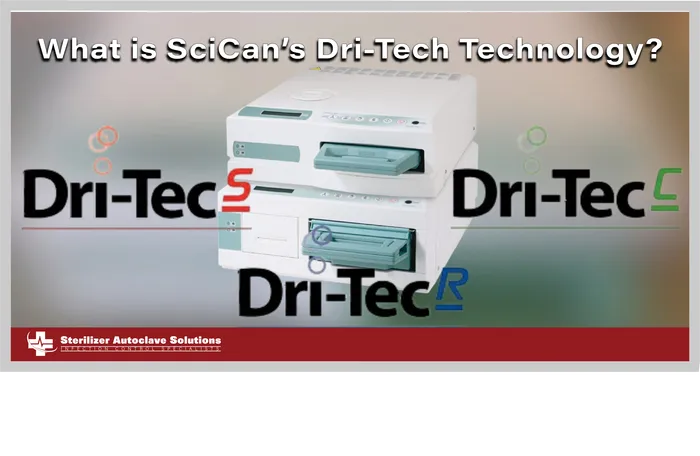
What is SciCan’s Dri-Tec Technology?
A large part of the evolution of sterilization technology has been adapting to fix recurring specific recurring issues. One of those issues in particular being wet sterilization packs. Wet packs can come from a number of different things ranging from a faulty pack to an inadequate sterilizer. No matter the source, wet packs can cause numerous issues with your sterilization workflow. Which is where SciCan decided to throw their hat into the ring to combat the issue.
SciCan’s various popular compact autoclaves, the Statim series, all have one thing in common: Dri-Tec. Dri-Tec is the name of SciCan’s proprietary drying technology. With each sterilizer using a different form of this revolutionary drying technology.
In this article, we’ll go over what each variant of this drying technology is. As well as covering what a wet pack is in the world of sterilization. That way you’ll not only understand the Statim autoclaves more… but you’ll also be able to see why proper drying in a sterilization cycle is as important as it is.
What Are Wet Sterilization Packs?
In autoclave sterilization, a “wet pack” is defined as a sterilization pack that has visible moisture—such as general dampness, water droplets, or puddles. These can be found either inside or on top of the packaging after a cycle. Wherever you find them, if you can see or feel moisture, it will lead to issues.
Wet packs pose a severe risk to the sterility of the instruments inside the packaging. Moisture can create a channel through the package, leading to microbial contamination. The packaging is meant to maintain the sterility of the tools inside without outside interference; if anything breaches it from the outside, the load is automatically considered contaminated. To prevent potential infection from using compromised instruments, any items in a wet pack must be reprocessed immediately.
Furthermore, if packs are coming out wet, it could point to underlying issues with the autoclave or the packaging itself. There might be a problem with the pouch, such as an unseen tear or breach, or an issue with your sterilizer. Either way, if any condition prevents instruments from being sterilized and dried properly, immediate troubleshooting is required.
With this being a prevalent issue in sterilization, SciCan took a step in a new direction by creating automated drying processes for their line of Statim autoclaves. These drying features enhance the drying process and aim to prevent wet packs altogether through the power of Dri-Tec.
Dri-Tec C (Convection Heat Drying)
The first instance of SciCan’s Dri-Tec technology is found in the Statim 2000. The Statim 2000 utilizes Dri-Tec C, with the “C” standing for Convection Heat Drying. Convection is the transfer of heat through the physical movement of fluids, such as liquids and gases, where warmer, less dense material rises and cooler, denser material sinks.
By utilizing heat remaining in the system after the sterilization phase, heat is captured and released into the cassette, drying wrapped instrument loads in as little as 10 minutes. When the active cycle is complete, the Statim 2000 uses residual thermal energy trapped in the cassette for this process. The heat circulates within the cassette chamber, and ambient heat evaporates any remaining moisture on the instruments.
This process comes together in a fast and efficient drying cycle, allowing the Statim 2000 to dry the load in just 10 minutes.
Dri-Tec R (Radiant Heat Drying)
The next variant of SciCan’s Dri-Tec exists within the Statim 5000 autoclave in the form of Dri-Tec R. The “R” stands for Radiant Heat Drying, which functions differently from the 2000 system. Because the Statim 5000 sports a larger cassette, its drying process requires a different approach.
TheStatim 5000 features unique drying plates located inside the sterilization chamber. Heat generated by the sterilization cycle is absorbed by these plates, and during the drying cycle, that thermal energy is transferred from the plates to the instruments via heat radiation. The plates offer uniform heat transfer across a larger surface area to accommodate the Statim 5000‘s larger loads, evaporating existing moisture with high-heat drying.
DriTec S (Superheated Steam Drying)
The final variant of Dri-Tec technology is inside the Statim 7000. The Statim 7000 utilizes SciCan’s Dri-Tec S variant, with the “S” standing for Superheated Steam Drying.
With Dri-Tec S, the Statim 7000 produces superheated steam to dry instruments. Instead of relying solely on external convection or thermal radiation, it extracts thermal energy directly from superheated steam during the drying phase. This heat is injected into the cassette to eliminate moisture directly on the packaging, creating an almost instantaneous reaction that evaporates clinging moisture.
Final Thoughts
Eliminating wet packs is about more than just keeping instruments dry—it is about protecting patient safety, preserving expensive surgical investments, and keeping your clinical workflow moving without frustrating bottlenecks. Traditional autoclaves that rely on lengthy drying cycles or archaic open-door methods leave too much room for human error and microbial contamination.
By engineering a tailored, proprietary drying solution for every size in their lineup—from the convection-driven Statim 2000 and radiant-plate Statim 5000 to the superheated steam power of the Statim 7000—SciCan transformed how medical and dental practices handle instrument turnaround. When you combine these advanced Dri-Tec systems with proper pouching techniques and regular maintenance, you ensure that every load emerges bone-dry, sterile, and ready for “just-in-time” patient care.
As always if you have any questions about this process or anything else please feel free to contact us and take advantage of our “FREE TECH SUPPORT.”
We also offer FREE VIRTUAL TECH SUPPORT to “See and Talk” with a “Real Time Live Technician” for any problems you may be in need of help with.
You can also use our “FREE MAINTENANCE PROGRAM”. Take the guesswork and worrying about what unit is due for maintenance and which maintenance cycle it is time for. We will keep track of all your autoclaves and let you know when it’s time for anything.
You can find more info on the Statim 2000 Classic autoclave on our site here. →
You can find more info on the Statim 5000 Classic autoclave on our site here. →