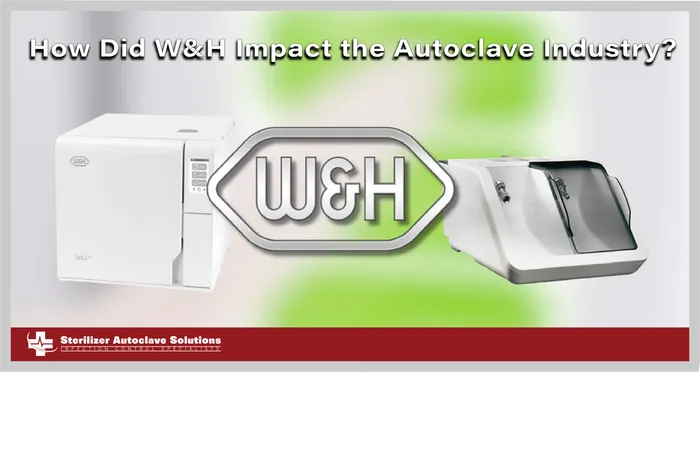
How Did W&H Impact the Autoclave Industry?
In our various articles and videos, we always talk about the innovative technology of many known names in the industry. Whether it’s sterilization technology like autoclaves, or other products for disinfection or infection control. Every brand we talk about has made a name for themselves in one way or another, but rarely do they go over how.
Which is why we want to take the time to spotlight some of these origins to show you how your favorite brand got its start. And in this article, we want to look at W&H. One of the most well-known names that created some of the iconic autoclaves and technology on the market today.
Where Did W&H Begin?
The W&H story began in 1890 in Berlin, Germany, when precision mechanics Jean Weber and Hugo Hampel established W&H Dentalwerk. Their mission was to manufacture precision straight and contra-angle handpieces for dentists according to emerging modern standards.
As dentistry transitioned into a formal medical science around the turn of the century, W&H quickly established a reputation for mechanical precision and reliability. In 1919, following World War I, the company was acquired by Adam Schneider AG, leading to an expanded production line that included full dental chairs.
1920s–1950s: Ownership Changes and the Relocation to Austria
By 1925, W&H was acquired by the German Gold and Silver Separating Works (DEGUSSA). Over the next decade, W&H drove several industry firsts, including introducing the market’s first press-button contra-angle handpiece and specialized miniature-head handpieces.
The turning point for the modern company occurred during World War II. In 1944, to escape the destruction of wartime Berlin, W&H relocated its operations to Bürmoos, Austria. Following the war, in 1946, the U.S. military administration appointed Dipl.-Ing. Peter Malata to manage the factory. Under Malata’s leadership, the company rebuilt its product line—producing foot-operated drilling machines, dental laboratory motors, and high-speed grinders. In 1959, Peter Malata officially purchased W&H, transitioning it into the family-owned enterprise that it remains today.
1960s–1980s: High-Speed Innovation and Key Patent Breakthroughs
The late 20th century marked an era of rapid technological breakthroughs for W&H:
- Air Motors and Turbines (1960s): W&H introduced air-operated ball-bearing turbines (such as the Turbo 60) and launched the Wispair air-bearing turbine, dramatically increasing drilling speeds and patient comfort.
- Press-Button Chuck System (1979): Changing dental burs previously required a separate bur-changer tool. W&H revolutionized clinical workflows by inventing the press-button chuck system, allowing practitioners to swap burs instantly with a thumb press on the head of the instrument.
- Surgical Expansion (1983): The company launched Elcomed, the most powerful surgical drive unit of its era, marking W&H‘s expansion into oral surgery and implantology.
1990s to the Present: Modern Sterilization and Tech
In the 1990s and 2000s, W&H expanded beyond instruments into comprehensive hygiene, sterilization, and digital technologies:
- Automated Maintenance & Sterilization: In 1992, W&H introduced Assistina, an automated handpiece maintenance system. This was followed in 1999 by the introduction of Lisa, one of the world’s first Class B tabletop sterilizers.
- Generator-Powered LED Instruments (2007): W&H introduced surgical contra-angle handpieces, their Synea line of handpieces, equipped with integrated generators. Similar to a bicycle dynamo, the mechanism produces bright LED illumination directly inside the handpiece without needing external power sources. Also, unlike other existing LED systems, these could be sterilized without hindering or damaging the light.
- The Launch of Lexa (2019): To meet specific demand and workflow requirements in the North American market, W&H launched the Lexa steam sterilizer in 2019. Manufactured in Brusaporto, Italy, Lexa brought a large 7.4-gallon chamber, dynamic pulsed air removal, and patented closed-door vacuum drying to high-volume practices.
- The Next-Gen Lexa Plus: W&H further evolved the platform with the Lexa Plus, integrating Eco Dry + technology—which automatically adjusts drying times to load mass—along with expanded 5-tray capacity, direct water-filling options, and advanced single-instrument traceability via EliTrace.
After some of it’s modern advancements, W&H continued its expansion by acquiring companies like Osstell in Gothenburg, Sweden. Ostell is a Swedish medical-technology company specializing in dental implant stability measurement and the patented Implant Stability Quotient (ISQ) technology. Following the acquisition, they continued to operate, but as a subsidiary of W&H themselves in Gothenburg.
And W&H continues to innovate in the market, evolving to meet the ever shifting tide of infection control technology.
What Has W&H Made?
We mentioned a bit about some of W&H’s technology, like the Assistina and Lexa units. So let’s take a look at each one to give you a better idea of why they were so important.
What is the W&H Assistina Twin?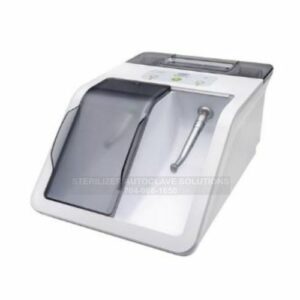
The W&H Assisitina Twin is here to help you ensure your handpieces get the attention they need. The Assistina Twin is a “handpiece reprocessing device.” Meaning it completely cleans and lubricates the inner workings of your handpiece. Not only can it accomplish this in record time, but it has a very unique way of keeping said records. It has a wealth of features that make it the best handpiece reprocessing device on the market.
- Easy to use, with a Quick Connect feature able to adapt to the fitting of any handpiece you need. And can be swapped on the fly for increased efficiency.
- Two chamber design for a fast output when lubricating your tools. As you’re putting the next tool in, your first one is already done.
- Able to give a thorough oil lubrication treatment in just 10 seconds. And utilizing a fine mist oiling process to get every part lubricated without setting anything in motion.
- With its capabilities and functions, it can turnout 360 instruments per hour.
- The Twin uses a smart process monitoring system that only uses what it needs as it needs it, and nothing more. Meaning its easy-to-change Care Set only needs to be changed every 2,800 instruments.
- And along with saving time and money, the Assistina Twin is completely eco-friendly. Ensuring that both your instruments and the environment stay clean.
With the Assistina Twin, even on your busiest days, your tools will always get the proper care.
What is the W&H Lexa Plus?
One of the standout W&H autoclaves featuring Eco Dry+ technology is the Lexa Plus. The W&H Lexa Plus brings an array of high-performance features to any practice. This tabletop autoclave offers a sturdy footprint (19.3” x 17.9” x 24.4”) paired with a spacious 7.4-gallon (24-liter) chamber built to handle your largest workloads.
The Lexa Plus utilizes Class B sterilization cycles, using pre-vacuum steam injection to sterilize even the most porous instruments with ease and efficiency. It also features versatile cycle options for various load types and an intuitive touchscreen display that guarantees complete workflow control. Automatic water filling further boosts efficiency, while built-in connectivity and traceability options adapt seamlessly to custom compliance needs.
Out of the box, the Lexa Plus emphasizes sustainability. Its environmentally friendly packaging is completely reusable and recyclable, with plastic components reduced to a minimum. By weight, 99% of the packaging is composed of cardboard and fully biodegradable substances.
Here are some of the other incredible features that you get with the W&H Lexa Plus:
- Eco Dry + technology, fast cycles and energy saving
- High capacity, 18 lbs. maximum load and optimized rack holds 5 trays
- Enhanced connectivity and traceability
- Convenient, automatic water filling saves time
- Class B, pre-vacuum sterilizer
- Versatile cycle program options for all types of loads
- Closed-door drying with HEPA filter
- Single-use distilled water management, ensuring fresh water for every cycle
Final Thoughts
From a modest workshop in 1890 Berlin to a world-leading medical device manufacturer headquartered in Bürmoos, Austria… W&H’s journey reflects a relentless commitment to clinical performance and safety. By continuously bridging the gap between mechanical engineering and automated infection control, W&H streamlines any modern practice. With flagship equipment like the Assistina Twin and the Lexa Plus, and their massive array of handpieces… W&H technology brings automation and efficiency to tackle the hardships during day-to-day work.
If you want to read more about W&H‘s different offerings, you can find them on our site here. If you have any questions about W&H’s autoclaves, disinfection devices, or anything else… Give us a call at 704-966-1650 Option 3, and we’ll help you find what you need.
As always if you have any questions about this process or anything else please feel free to contact us and take advantage of our “>FREE TECH SUPPORT.”
We also offer FREE VIRTUAL TECH SUPPORT to “See and Talk” with a “Real Time Live Technician” for any problems you may be in need of help with.
You can also use our “FREE MAINTENANCE PROGRAM”. Take the guesswork and worrying about what unit is due for maintenance and which maintenance cycle it is time for. We will keep track of all your autoclaves and let you know when it’s time for anything.
You can find more info on the W&H Lexa Plus Sterilizer on our site here.
You can also find more info on the W&H Assistina Twin on our site here.