
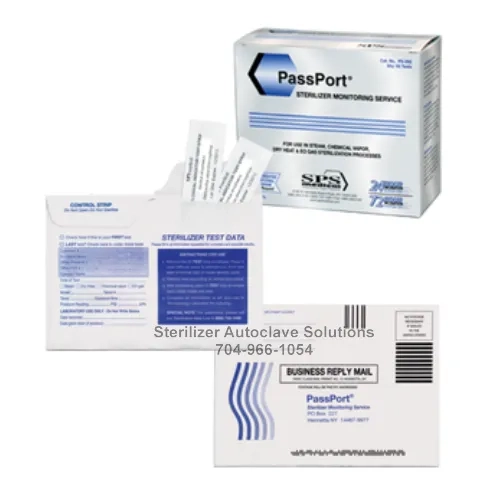
Crosstex PassPort™ Biological Sterilizer Monitoring Service
This system provides 3rd party legal documentation of sterilization test results.
Two test strips and one control strip are provided for users to spore test multiple locations within the sterilizer chamber.
- EO Gas test results are completed and reported back to the customer after 7 days incubation.
- Dry Heat test results are documented and reported back to the customer after 7 days incubation.
- Steam test results are documented and reported back to the customer after 24 hours incubation.
- Chemical Vapor test results are documented and reported back to the customer after 72 hours incubation.
This system allows access to spore test results on-line (www.checkyourtest.com), and includes prepaid envelopes for each test.
$184.00
Spore Testing FAQ’s
Q: How often should sterilizers be spore tested?
A: According to the CDC, sterilizers should be tested at least weekly and every load that contains an implant. AAMI and AORN standards recommend steam sterilizers be spore tested at least weekly, preferably daily and every load that contains an implant. Low temperature sterilizers, i.e. EO gas and hydrogen peroxide processes, should be spore tested each load. Canadian Standards (CSA) say to test sterilizers the first load of the day and every load that contains an implant.
Q: Why do you incubate tests at different temperatures?
A: The G. stearothermophilus spores used to test Steam and Chemical Vapor sterilizers thrive at 132.8°F (56°C), while the B. atrophaeus spores used to test Dry Heat and EO gas require incubation at 98.6°F (37°C).
Q: What causes a sterilizer to fail?
A: While sterilizers can and do mechanically fail from time to time, i.e. worn door gasket, seals, pressure release value and/or heating coils, operator error is considered the leading cause of sterilizer failure. Users must be careful not to over load the sterilizer or run the sterilizer from a cold start. Improper packaging and/or selecting the wrong sterilizer cycle parameters can also lead to sterilizer failures. Staff should be trained on how to properly reprocess reusable devices and understand the importance of sterilization – including selecting the correct packaging system, chemical indicator, biological indicator, and running the appropriate sterilization cycle.
Q: What should be done if a sterilizer fails the spore test?
A: According to the CDC, sterilizers that fail the spore test should be taken out of service and retested (after operator review of correct procedures). If the sterilizer fails a second spore test, the sterilizer should be professionally repaired and not used until it passes multiple spore tests.
Q: Does it matter what type of water I use in my autoclave?
A: YES it does. Only use the type of water specified by the sterilizer manufacturer, i.e. distilled or purified. Using tap water can cause mechanical failure and possibly void the sterilizer warranty.
Q: When is the best time of the day to spore test my sterilizer?
A: While you can run the spore test at any time during the day, being consistent with your testing can help prevent operator errors. It is considered routine to test the first load of the day, each day that you spore test your sterilizer(s). For sterilizers that have been turned off or not used in a long time, a warm up cycle is recommended prior to spore testing. CSA recommends testing the first load of the day.
Q: Should I run my spore test an empty sterilizer?
A: Sterilizers should be routinely tested with a load that is representative of the items the healthcare facility processes, i.e. instruments inside peel pouches or wrapped trays. You want the spore strip(s) to see the same conditions that your sterilized items do. For new sterilizer installation or those that have been repaired, three (3) consecutive empty sterilizer tests are recommended prior to placing the unit back into service.
Based on 0 reviews
Only logged in customers who have purchased this product may leave a review.
Related products
-
Infection Control, Instrument Processing, New, Propper Vapor Line Steam Type 5 integrators, Sterilization, Sterilization Monitoring
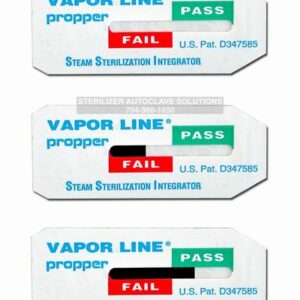
Propper – Vapor Line Steam Sterilization Type 5 Integrators packet of 250 OEM 26900925
 Infection Control, Instrument Processing, New, Propper Vapor Line Steam Type 5 integrators, Sterilization, Sterilization Monitoring
Propper – Vapor Line Steam Sterilization Type 5 Integrators packet of 250 OEM 26900925
FREE SHIPPING!
Propper – Vapor Line Steam Sterilization Type 5 Integrators packet of 250 OEM 26900925
The Vapor Line® Integrator is a chemical indicator for monitoring the essential conditions of steam sterilization processes – saturated steam, temperature, and time in gravity displacement and pre-vacuum sterilizers operating in the 250°F – 272°F temperature range.
SKU: 26900925

There are no reviews yet.